


You slot a second 20% increased damage support gem expecting your tooltip to jump the same amount it did the first time. It does not. Damage multiplier stacking in POE punishes exactly this assumption, and the gap between what you expect and what you actually get gets bigger the more modifiers you pile into the same bucket. Once you understand why, half the confusing poe damage scaling math in this game stops being confusing.
Two Buckets Behind Damage Multiplier Stacking in POE
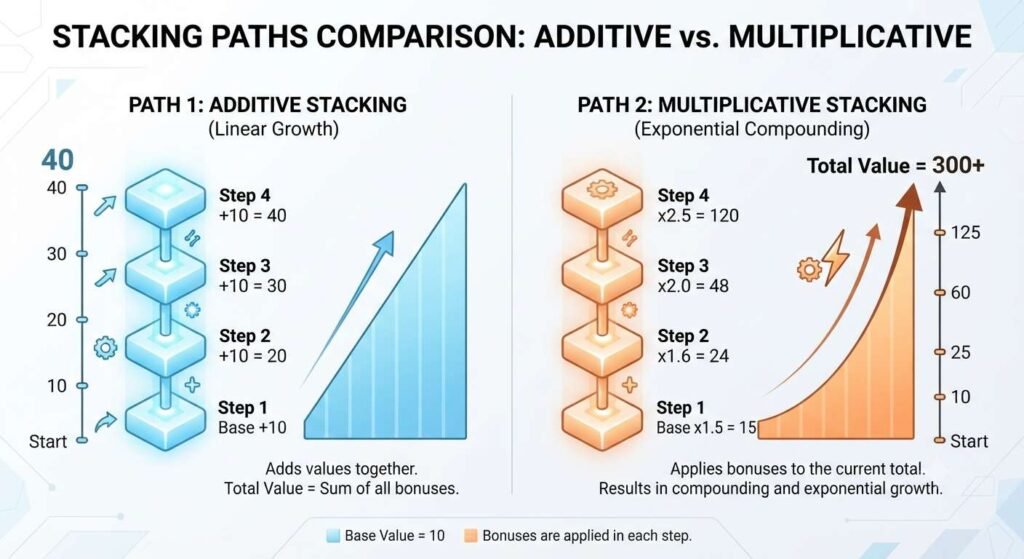
The whole question of increased vs more poe modifiers comes down to two buckets. Every damage modifier in the game falls into one of two buckets, and which bucket it lands in changes everything about how it behaves once you start stacking more of them. Additive damage modifiers poe players deal with constantly work like this: increased and reduced modifiers are additive, with every other increased or reduced modifier affecting that damage type. More and less modifiers are multiplicative, applied as a separate step after all the additive modifiers have been summed together.
Here is what that actually looks like with real numbers. Add 20% increased fire damage, and your multiplier goes to 1.2. Add a second, unrelated 20% increased elemental damage modifier, and it does not multiply to 1.44; it adds into the same additive pool, taking you to 1.4 total, a 1.2 to 1.4 jump. That second 20% only bought you a 16.67% relative increase, not the full 20% the number on the gem promised you.
This is multiplicative damage poe territory, and it behaves completely differently. Now compare that to a more modifier. A support gem granting 20% more damage multiplies whatever you already have by 1.2 outright, every single time, with no diminishing return relative to other more modifiers. Stack two of them, and you get 1.2 times 1.2, which is 1.44, a genuine compounding effect rather than a shrinking one. This is exactly why more modifiers, found mostly on support gems, are treated as premium damage in both games, and why increased modifiers, however plentiful on the passive tree, deliver steadily worse returns the more of them you already have.
Why This Matters More in POE 2 Than People Expect

POE 2 kept the same additive-versus-multiplicative split from the first game, but it changed at least one number that catches veterans off guard. The poe 2 crit multiplier is the clearest example of this. Critical strikes in POE 2 carry a base 100% more damage bonus. In the first Path of Exile, that same baseline poe 2 crit multiplier equivalent sits at 150% more damage instead. Anyone porting build math directly from legacy POE into POE 2 without checking this number will overestimate their crit-based damage by a meaningful margin before they have even accounted for gear.
Damage multiplier stacking in POE 2 specifically also interacts with the game’s more granular damage taken calculations. Increases and reductions to damage taken sum together the same way offensive increased modifiers do, while more and less modifiers to damage taken apply as their own multiplicative step, following the same two-bucket logic as offense but on the defensive side of the equation. Additive damage modifiers poe uses for damage taken work the same way defensively: a build stacking multiple sources of increased damage taken from debuffs like Wither or Shock is not stacking those effects as cleanly as the tooltip implies, since they are competing for space in the same additive pool rather than compounding freely.
How to Actually Use This When Building a Character
Good poe damage scaling starts with this priority: favor more multipliers over increased multipliers once you already have a reasonable amount of increased damage from the tree and gear. The tenth source of increased damage on your character delivers a fraction of the value the first one did. In contrast, a fresh more multiplier from a support gem or ascendancy node delivers its full advertised value regardless of what you already have. This is the actual mechanical reason experienced players prioritize support gem slots and specific ascendancy nodes with more damage over grabbing every increased damage node within reach on the passive tree.
Damage multiplier stacking in POE also explains why certain skills with built-in more multipliers, the kind baked directly into a skill’s own damage tag rather than added through supports, scale so differently from generic attacks. That is multiplicative damage poe compounding at work: a skill that already carries a large inherent more multiplier compounds every additional more modifier you add on top of it, which is part of why some skills feel disproportionately powerful once fully supported. In contrast, others plateau no matter how much increased damage you throw at them.
When comparing two possible upgrades of similar apparent value, a flat percentage on a support gem labeled “more” is almost always the stronger pick over a similarly sized “increased” modifier on a passive node, unless your increased damage total is unusually low. The increased vs more poe distinction decides that answer every time, so check which bucket a modifier actually belongs to before assuming two similarly worded bonuses are functionally the same size.
A quick gut check that works without a spreadsheet: count how many increased damage sources you already have active. Fewer than three or four, and another increased modifier is still worth roughly its stated value. Past five or six, treat any new increased modifier as worth about half its stated number, and go looking for a more multiplier instead if one is available anywhere in your build’s remaining slots. That single habit is most of what good poe damage scaling actually comes down to in practice.
Quick Checklist — Understanding Damage Multiplier Stacking in POE
- Confirm whether a modifier says increased or more, since increased vs more poe wording is the entire mechanic.
- Remember additive damage modifiers poe uses for increased and reduced effects of the same damage type sum together.
- Remember multiplicative damage poe modifiers, more and less, apply multiplicatively, each one compounding fully.
- Expect diminishing relative returns from your fifth or sixth source of increased damage.
- Emphasize more multipliers from support gems and ascendancy nodes once increased damage is already high.
- Do not assume poe 2 crit multiplier math transfers directly from legacy POE; the base values differ.
- Check damage taken modifiers the same way; they follow the identical additive versus multiplicative split.
- Recalculate rather than assume when comparing two upgrades that both use percentage language.
Once you can look at any modifier and immediately sort it into the additive bucket or the multiplicative one, damage multiplier stacking in POE stops being an opaque wall of percentages. It starts being a straightforward budgeting problem you can actually plan around.