poe.ninja

What is poe.ninja

poe.ninja is a free analytics platform built for Path of Exile, turning a fully player driven economy and an ever changing build meta into clear, navigable data.

Prices for currency, unique items and divination cards shift constantly, often within hours of a league start. poe.ninja pulls live data directly from the game and presents it through clean dashboards covering economy trends, currency exchange rates, item valuations and the most popular builds used by top players, so every decision you make in game is backed by real numbers instead of guesswork.

Live economy data
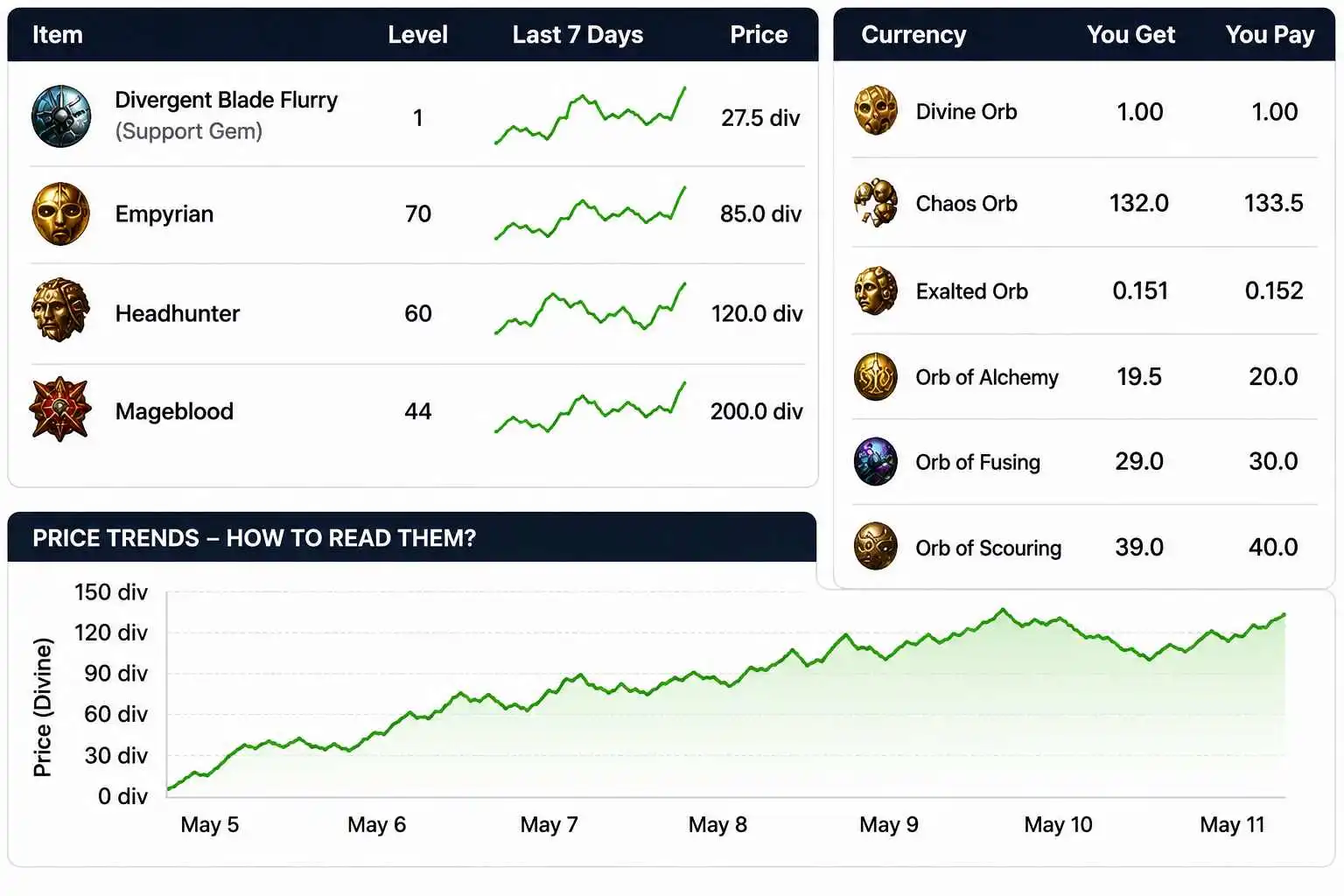
Live economy data Track currency exchange rates, divination cards and item prices as they move, updated continuously throughout the league.
Build meta insights
Build meta insights See which skills, ascendancies and unique items top players are using right now, filtered by class and ladder rank.
Historical trends
Historical trends Explore historical graphs to understand how prices and the meta evolved across the current and past leagues.
PoE 1 & 2 Full coverage of both games
Live Continuously updated data
Free No account required
How it works

How Poe Ninja Works

Poe Ninja connects directly to data sources maintained by Grinding Gear Games, then processes everything into accurate, easy to read overviews for both economy and character builds in Path of Exile.

1

Pulling raw economy data

Every tradeable currency, divination card and unique item listed in public stash tabs is collected through the official public stash tab API, covering all active leagues for both Path of Exile and Path of Exile 2.

2

Filtering out noise

Raw listings are never used as is. Outliers, price fixed entries and inflated asking prices are filtered through statistical analysis so the final value reflects real trade activity rather than wishful pricing.

3

Reading the ladder for builds

Character build data is gathered from the official ladder, capturing passive skill trees, skill gems, ascendancies and equipped unique items from the highest ranked players currently active in each league.

4

Updating continuously

Both economy and build datasets refresh on an ongoing cycle throughout the day, keeping prices, trends and meta snapshots aligned with what is actually happening in the current league.

5

Presenting clear overviews

All of the processed information is organised into searchable, filterable dashboards across economy, builds and atlas tree sections, so any player can find answers in seconds without digging through raw data.

A research tool, not a marketplace

Poe Ninja does not process trades or transactions. It is purely an information resource that helps players price items accurately, plan builds with confidence and understand where the Path of Exile economy is heading.

Economy

Economy Currency - Runes of Aldur - Path of Exile 2

Path of Exile has a currency system consisting of various orbs and scrolls with no fixed value. Keeping on top of fluctuating exchange rates between the different currencies is almost impossible.

Explore the current economic landscape, discover exchange rates between different currencies, track prices of items across an ever increasing number of categories.

Live updating overviews keep information flowing to your browser and historical graphs are available for exploring the past.

Economy-Currency-Runes-of-Aldur-Path-of-Exile-2-
Economy

Item and Unique Prices Explained

Unlike currency, every item in Path of Exile carries its own individual value shaped by rarity, demand from active builds and how difficult the item actually is to obtain.

Unique items have fixed properties, so two copies of the same unique are never identical in the way two crafted rares can be. A regular unique that drops anywhere in the game tends to sit at a modest price, while items locked behind specific bosses, league mechanics or drop restrictions command a premium simply because supply is limited no matter how strong demand becomes. Rare items work differently since their value depends entirely on the combination of modifiers rolled onto them, meaning two visually identical rares can be worth wildly different amounts. Poe Ninja tracks both categories separately, surfacing average prices alongside the specific rolls or variants that push an item above the baseline.

Where value typically lands

Common Open drops, low demand
Sought after Strong build relevance
Restricted Limited drop sources
Chase item Rare and high demand
Drop restrictions Items tied to a single boss, league mechanic or area carry a price premium simply because supply cannot scale with demand the way common drops can.
Build relevance A unique that enables a popular or powerful build will see demand and price climb together as more players chase the same item.
Roll quality Rare items and uniques with rollable ranges are priced individually, so a perfect roll can be worth many times more than an average one.
League timing Prices are highest in the opening days of a league when supply is scarce, then settle lower as more copies enter circulation over time.

How Poe Ninja prices each item

Listings are pulled from public stash tabs across the league, then filtered to remove price fixed entries and outliers before a representative chaos value is calculated. For items with meaningful variance, such as different corruption outcomes or roll ranges, separate entries are shown so the price always reflects the specific version of the item rather than a single blended average.

Builds

Builds - Path of Exile 2

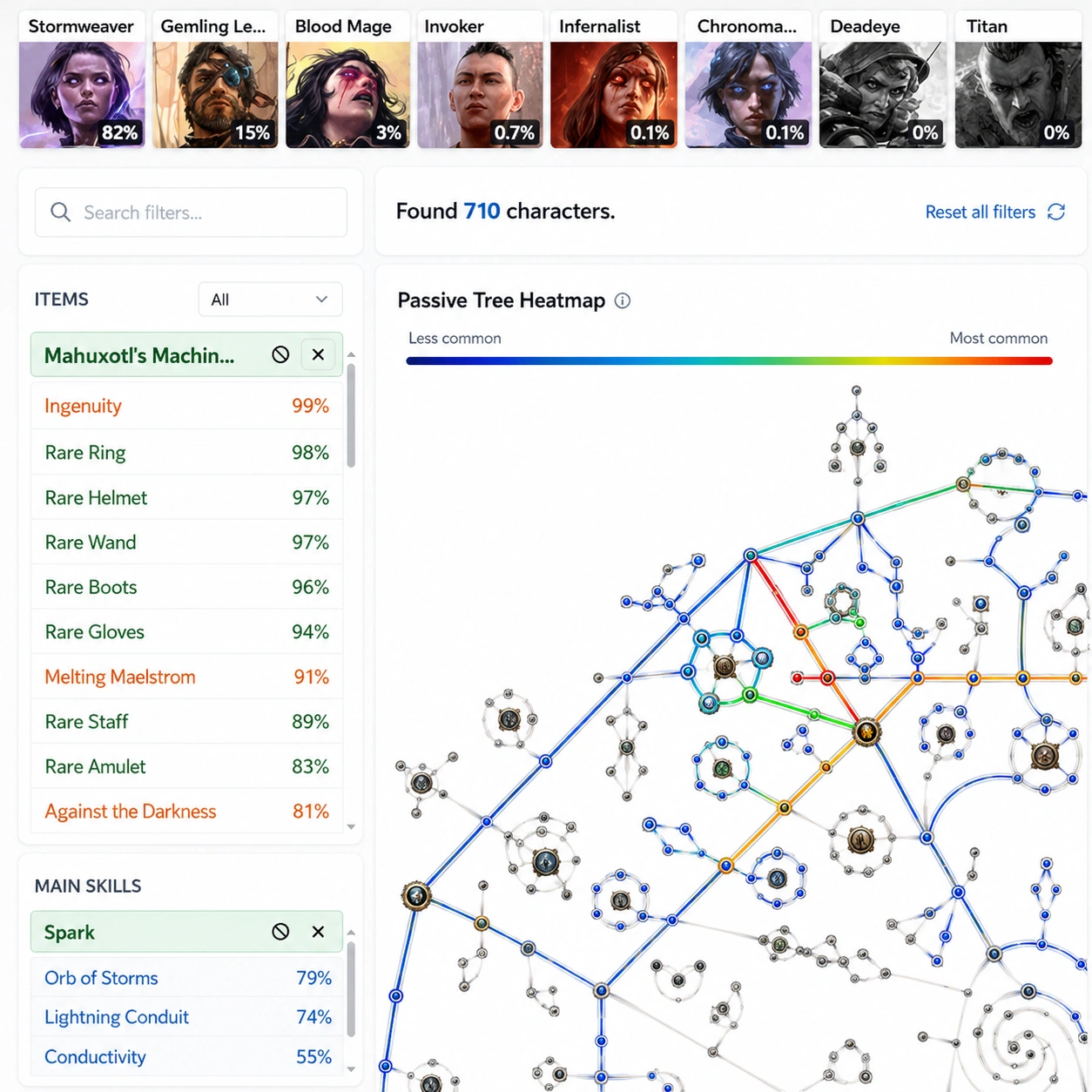
Explore the current build meta in Path of Exile 1 and 2. Discover the most popular builds used by top players on the ladder. Review your passive skill tree by looking at the passive skill tree heatmap and see if you missed any important nodes.

Slice and dice the data rapidly to find inspiration for your next build. Filter by class, items, skill gems, linked gems, passive skills, keystones, anointed passives, weapon configuration and more. Find off meta characters by excluding certain items or skills. Enable more columns to filter and sort by niche stats.

Integrated with Path of Building for simulated stats and allows for quickly importing a character into Path of Building for further exploration.

Builds Path of Exile 2

Build Overviews Explained

Build overviews turn the ladder of every active league into a searchable snapshot of what top players are actually running right now, rather than a guess based on forum chatter.

Each overview is generated from the public ladder, capturing the full character setup of high ranking players including class, ascendancy, main skill, support gems, passive tree allocation and equipped items. Filtering this dataset by class, skill or keystone reveals which combinations are currently dominating the meta and which ones remain underused, often pointing toward strong but overlooked builds. Because data comes straight from the ladder rather than community submissions, the picture stays accurate even as the meta shifts week to week.

1

Reading the ladder

Character data is gathered from high ranking accounts on the official ladder, including class, ascendancy and overall character progress.

2

Capturing the full setup

Main skill, linked support gems, passive skill tree allocation, keystones and equipped unique items are recorded for every character in the dataset.

3

Filtering by what matters

Results can be narrowed by class, skill gem, keystone or item, making it possible to find off meta characters or compare popular variations side by side.

4

Visualising the passive tree

A heatmap of node allocation density highlights which areas of the passive tree are most popular among the filtered set of characters.

5

Exporting for further use

Any character can be exported directly for simulated stats and theory crafting, allowing quick comparisons before committing to a respec.

Why build overviews matter

Theory crafting from scratch is slow and easy to get wrong. Build overviews shortcut that process by showing exactly what already works at the highest levels of play, then let any player adapt those proven setups using Path of Building for deeper simulation and planning.

Path of Building (PoB) Integration

Path of Building is the community standard tool for calculating damage, defenses and item effectiveness in Path of Exile, and every build overview on Poe Ninja connects to it directly.

Instead of recreating a build by hand inside Path of Building, any character listed in the build overviews can be exported with a single click. The passive tree, equipped items, skill gem links and ascendancy all transfer together, giving an accurate starting point for simulated stats rather than a rough approximation. This shortcuts the most time consuming part of theory crafting, letting a player test gear swaps, support gem changes or passive tree adjustments against real numbers before committing any in game currency.

01 Full character export Passive tree, items, skill links and ascendancy transfer together as a single export, not separate pieces that need manual reassembly.
02 Accurate DPS simulation Once imported, Path of Building calculates damage, defenses and resource costs using the exact same modifiers the character has equipped.
03 Safe experimentation Gear, gem and passive changes can be tested in the simulation first, avoiding wasted currency on respecs or upgrades that turn out weaker.
1 Browse builds Find a character on the ladder overview
2 Export with one click Generate a Path of Building code instantly
3 Import and explore Open in Path of Building to test and adjust

Get Path of Building

Download the open source planner used to simulate every exported build.

View on GitHub
Atlas Trees

Atlas Trees - Path of Exile 1

Explore atlas tree allocations across leagues in Path of Exile 1. Browse and filter trees by invested mechanics, keystones and beacons to discover what strategies players are using in the endgame.

Whether you are optimizing for fun or profit, see what others are doing and find the right tree for your goals. View a heatmap of node allocation density to see which areas of the atlas tree are most popular.

Click through to detailed tree views with full stat breakdowns including scarab spawn chances, blocked mechanics and point allocation summaries.

Atlas Trees - Path of Exile 1 Atlas Trees - Path of Exile 2
Atlas Trees Path of Exile
Passive Skill Tree

Passive Skill Tree - Path of Exile 2

The passive skill tree is a core part of Path of Exile 1 and 2 and a vital part of planning your character.

Explore the passive skill tree in a tool built for smooth performance on both desktop and mobile. It aims to offer an intuitive experience for planning and optimizing your builds. Effortlessly navigate the tree, explore skill combinations, and gain insights with the integrated stat overview.

Share trees easily using the integrated share functionality and lock the tree to avoid making accidental changes.

Passives - Path of Exile 1 Passives - Path of Exile 2
Passive Skill Tree Path of Exile 2

Skill Gem Prices Explained

Skill gems behave like a market of their own inside Path of Exile, where level, quality and the amount of experience invested all combine to set a price far above a freshly bought copy.

A brand new gem from a vendor starts at level one with no quality and very little resale value. Players invest hours of experience leveling gems and apply Gemcutter Prisms to raise quality, and both of those investments are reflected in the trade price once the gem is sold rather than used. The most sought after combination is widely known as a twenty twenty gem, meaning level twenty with twenty percent quality, since it represents the maximum practical benefit most builds need without the steep experience cost of pushing further. Awakened gems and gems with corrupted quality above the normal cap sit in their own tier entirely, often trading for many times the price of a standard high level copy.

Gem level Higher levels unlock stronger effects and lower mana costs on many skills, making fully leveled gems consistently more valuable than fresh copies.
Quality percentage Quality grants a secondary bonus unique to each gem, so a high quality copy is worth more even at the same level as a zero quality version.
Awakened variants Awakened support gems provide stronger bonuses than their regular counterparts and are limited by how they are obtained, keeping prices consistently high.
Corrupted outcomes Corruption can push a gem beyond its normal level or quality limit, and these enhanced copies are tracked and priced separately from standard gems.

Why gem prices vary so much

Two gems with the same name can sell for very different amounts depending on level, quality and corruption state. Poe Ninja separates these variants in its listings rather than blending them into a single average, so the price shown always matches the specific combination a player is looking to buy or sell.

Share Path of Building Code

Path of Building - Path of Exile 1

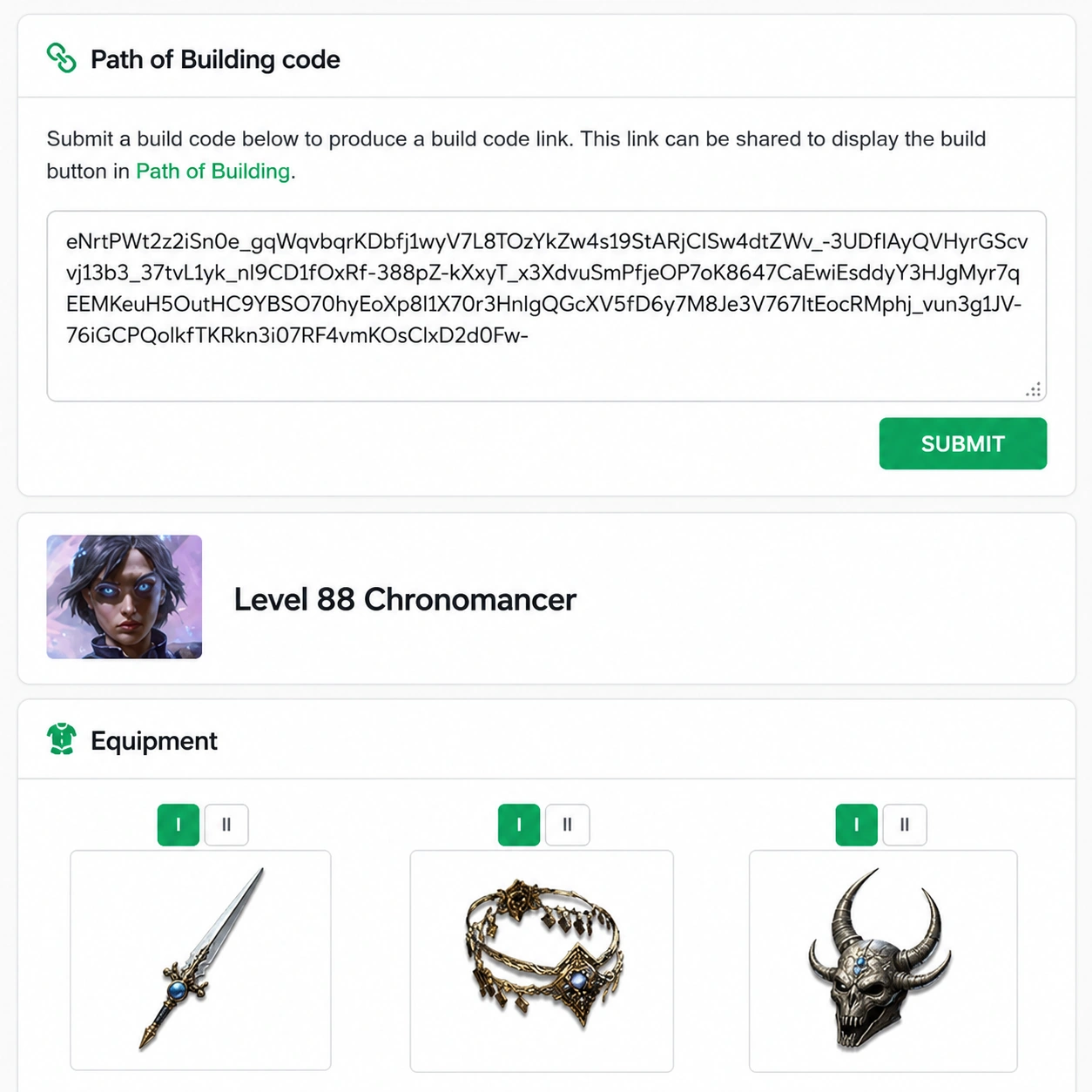
Upload Path of Building codes either from within Path of Building in the Import/Export section or directly the upload page to share with others.

The provided link can be used in a browser to quickly browse the details or imported directly into Path of Building through the Import/Export section.

Share Path of Building Code
Comparison

Path of Exile 1 vs Path of Exile 2 Data

Path of Exile and Path of Exile 2 run as separate games with separate economies, separate ladders and separate metas, which is why Poe Ninja tracks each one independently rather than blending them together.

Currency, items and builds never carry over between the two games, so a chaos orb in Path of Exile holds no relationship to one in Path of Exile 2, and a top tier build in one game says nothing about what works in the other. Understanding where the two diverge helps explain why Poe Ninja maintains fully separate economy, build and atlas tree sections for each game rather than a single merged view.
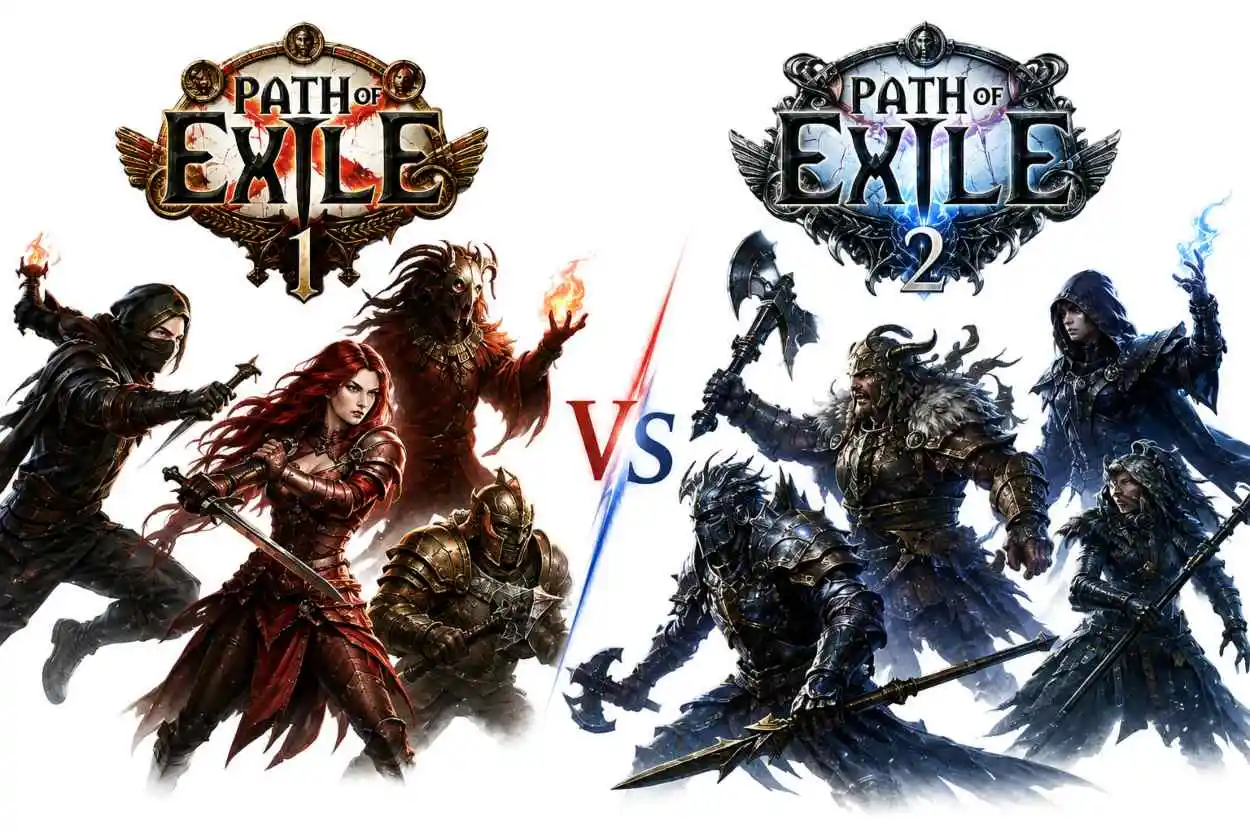
Path of Exile
Fast paced, mature economy
VS
Path of Exile 2
Tactical, early access evolving
Path of Exile
Path of Exile 2
Combat pacing Fast, built around clearing large groups quickly Deliberate, focused on positioning and boss timing
Currency model Orbs and scrolls act as both crafting tools and trade medium Gold handles vendor trades, orbs remain the player trading layer
Gem sockets Sockets live on gear, six link items are a key crafting goal Sockets live on skill gems, making build changes far easier
Class count Seven base classes with their respective ascendancies Twelve base classes, each with multiple ascendancy choices
Mobility Movement skills drive rapid map traversal Universal dodge roll plus weapon swapping for active mobility
Market maturity Long running economy with established pricing patterns Still settling through early access, with prices shifting more between patches

Why separate tracking matters

Treating both games as one dataset would blur prices, build popularity and meta trends that have nothing to do with each other. Poe Ninja keeps every economy, build and atlas tree view split by game so the numbers always reflect the correct ladder and the correct market.

Getting started

How to Choose the Correct League

Every league in Path of Exile and Path of Exile 2 starts with a fresh economy, meaning the league a player picks shapes everything from trading options to how punishing a single mistake can be.

Three independent choices combine to define a league: whether to play the current challenge league or a permanent league such as Standard, whether trading with other players is allowed or restricted to Solo Self Found, and whether character death is permanent under Hardcore rules. None of these choices are locked together, so a player can mix and match based on how much risk and social interaction they actually want from a given season.

?

Do you want a fresh economy or an established one

Challenge league Standard
?

Do you want to trade with other players

Trade league Solo Self Found
?

Should character death be permanent

Softcore Hardcore
New players Trade league, softcore The most forgiving combination, with a living economy to buy from and no penalty for dying while learning the game.
Solo focused Solo Self Found, softcore Every item is earned rather than bought, rewarding self sufficiency without the added pressure of permanent death.
High risk Hardcore, trade or Solo Self Found A single mistake ends the character for good, suited to experienced players seeking the highest possible stakes.

Why league choice matters for tracking data

Each league produces its own economy, ladder and meta from scratch, so prices and build popularity in a fresh challenge league are never comparable to Standard, Solo Self Found, or Hardcore. Poe Ninja separates data by league for exactly this reason, ensuring every price and build statistic reflects the specific league a player is actually checking.

Use cases

Why Traders and Build Crafters Use Poe Ninja

Two very different types of players rely on Poe Ninja for opposite reasons, yet both depend on the same underlying data feed updating accurately throughout the league.

01

Currency traders

Pricing accurately before every transaction

Traders check current exchange rates before buying or selling anything, since accepting a stale price can mean losing value within hours. The economy section answers exactly what an item or currency is worth right now, removing the need to manually browse listings or guess based on outdated memory.

02

Flip traders

Spotting profit before the crowd catches on

Cross referencing the builds section against the economy section reveals items growing in demand before their price has fully caught up, giving flip traders a window to buy low ahead of a predictable price increase tied to a rising build trend.

03

Build crafters

Starting from what already works

Rather than theory crafting blind, build crafters filter the ladder by class, skill or keystone to see proven setups from top ranked characters, then export directly into Path of Building to test variations before committing any currency in game.

04

League starters

Navigating the chaos of a fresh economy

In the opening days of a league, prices and the meta shift by the hour. Continuously updated overviews let league starters react quickly rather than relying on outdated guides written before the league even began.

Without a live tracker, pricing anything in this economy is essentially guesswork.

Trading focused players

Seeing what top ladder characters actually run beats theory crafting from a blank passive tree.

Build focused players

One dataset, two different goals

Whether the goal is profit or performance, both groups depend on the same continuously updated information pulled from public stash tabs and the official ladder, processed and filtered before it reaches the dashboard.

Behind the data

Data Sources and Update Frequency

Every number shown on Poe Ninja traces back to an official Grinding Gear Games data source, processed through a continuous pipeline rather than a manual update routine.

Economy figures originate from the public stash tab API, a live stream of every public stash tab change across the game servers, while build figures come from the official ladder API ranking characters by experience. Both feeds are consumed continuously, meaning the dashboards reflect the state of the game within minutes rather than waiting on a scheduled batch job that runs once or twice a day.

Live feed status
stash_tab_api Receiving continuous public stash tab change stream just now
price_engine Filtering outliers and price fixed listings 2s ago
ladder_api Refreshing top ranked character snapshots 6m ago
atlas_sync Aggregating passive tree allocation data 18m ago
Live Currency prices Updated as new listings stream in from the public API
Rolling Item and unique prices Recalculated continuously as listings shift
Daily Build overviews Refreshed multiple times throughout the day

Statistics and Data Dumps Overview

Beyond the dashboards, the underlying figures that power Poe Ninja are also visible in raw form, giving developers and curious players a way to verify exactly what is being processed.

A public statistics page exposes the most recent update identifier and timestamp for the stash tab stream, the same reference point third party tools use to confirm they are reading current data rather than a stale cache. This transparency matters because the entire pricing model depends on trust in the underlying feed, and being able to verify the last successful update removes any doubt about whether the numbers on screen are current.

Raw listing volume Every public stash tab change captured straight from the stream
Full volume
Filtered listings Outliers and price fixed entries removed through statistical analysis
Reduced set
Aggregated summaries Final per item and per currency values published to the dashboard
Final output

Why visibility into the pipeline matters

A pricing tool is only as trustworthy as the data feeding it. Showing the source, the processing steps and the update cadence openly gives every player a way to understand exactly how a number reached the screen rather than treating it as a black box.

Help

Frequently Asked Questions

Quick answers to the questions players ask most often about characters, builds, pricing and how the site works. The full FAQ covers additional topics in more depth.

Characters and ladder Builds and Path of Building Economy General
Characters Why is my character not showing up on the ladder
+

Build overviews are generated from the official Path of Exile ladder API, which only lists characters that rank high enough by experience, or by Solo Delve depth in Path of Exile. Checking the official ladder pages directly for the current league shows the level and experience threshold currently required to appear.

Characters Why is my character listed under the wrong main skill
+

The ladder API occasionally reports a secondary weapon set as the primary one, since builds vary so much that automatically detecting the true main skill is genuinely difficult. This is a known limitation of the underlying data rather than a display choice.

Builds How is DPS calculated for each build
+

Damage figures are generated using the Path of Building community fork, configured to approximate damage against a standard high level boss target since that is the comparison most players expect when judging build strength.

Builds Can I see the exact configuration used for a build
+

Every character has an export option that generates a Path of Building code, which can be imported directly to inspect the exact configuration used for that specific build, including which modifiers were factored into the damage calculation.

Economy Why did a price change so quickly
+

Prices are recalculated continuously from live stash tab listings, so a sudden shift in supply, a balance change, or a new crafting method can move a value within hours. This is normal behavior for a fully player driven economy rather than a tracking error.

Economy Why does Standard show different prices than the current league
+

Every league runs its own independent economy starting from zero, so prices in Standard reflect years of accumulated wealth while a fresh challenge league reflects only the current season. The two are never directly comparable.

General How do I get listed on the streamers page
+

Linking a Path of Exile account to a Twitch account through the official Path of Exile website is required, along with either appearing on the official ladder or logging in with that account on the site, and meeting the current follower threshold on Twitch.

More questions answered

The full FAQ covers additional guides, configuration rules and account topics in more detail.

View full FAQ