
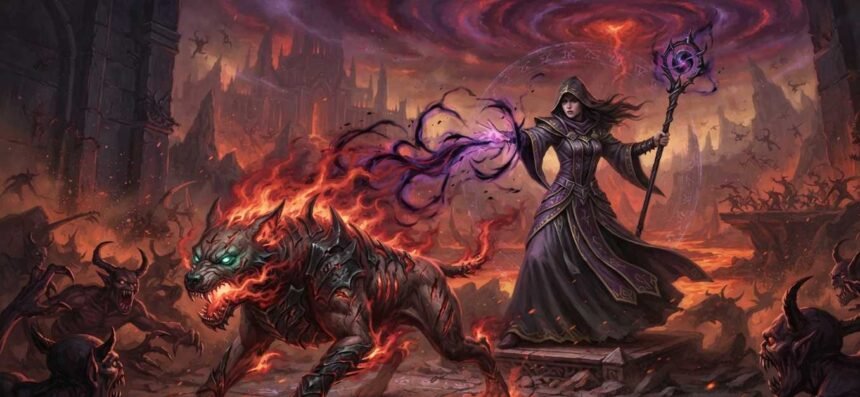
Every Infernalist build guide refers to the hellhound in passing, a sentence or two, then moves straight to spell rotations as if the companion were decorative. The POE 2 Hellhound skill is not decorative. It is one of the defining tools of the entire Infernalist ascendancy, and treating it as a background pet instead of a build pillar is the single biggest mistake new Infernalist players make.
What the POE 2 Hellhound Skill Actually Is
The hellhound is a companion tied specifically to the Infernalist ascendancy poe 2 players choose, the demonform fire-focused Witch ascendancy built around infernal pacts and hellish transformation. Unlike a standard summoned minion conjured through a skill gem, the hellhound functions as a persistent companion attached to your ascendancy identity itself, fighting alongside you as an extension of the Infernalist’s demonic theme rather than as a separate minion build layered on top of a caster.
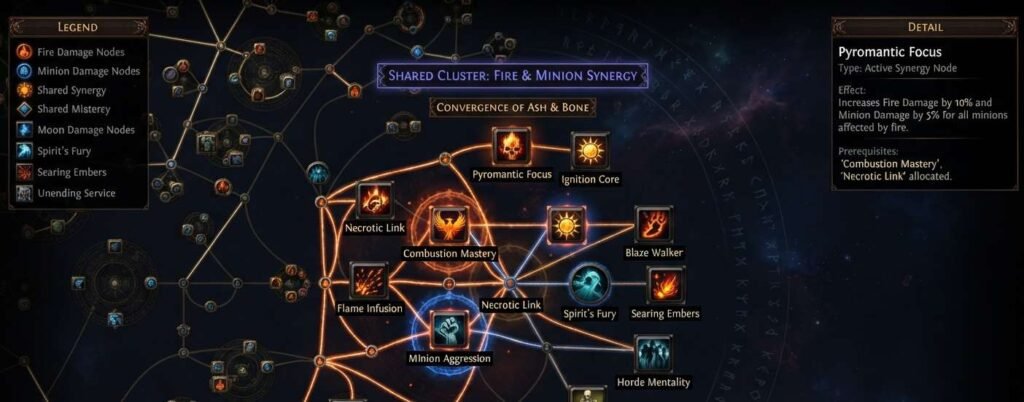
The POE 2 Hellhound skill scales mainly through the same fire and minion-adjacent investment that supports the rest of an Infernalist’s kit, which is exactly why it rewards being treated as a core part of the build rather than an afterthought. A player who ignores poe 2 minion scaling and companion nodes on the passive tree gets a fire hound that looks the part but contributes a fraction of what it could to actual damage output.
Concretely, this means the POE 2 Hellhound skill should factor into gem link decisions the same way any other core damage skill does, not sit in an unsupported four-link while your main spell gets the full six-link treatment. Support gems that boost minion damage, fire damage, or area effect all meaningfully improve what the hellhound contributes, and treating its link setup as an afterthought caps its output regardless of how much passive tree investment you route toward it elsewhere.
Infernalist Hellhound Companion Scaling in Practice

Infernalist hellhound companion strength ties closely to how much fire damage and minion-related investment you route through your build overall, since the companion benefits from many of the same modifiers your own spells already want. This coincidence is part of what makes an infernalist hellhound companion unusually efficient compared to a fully separate minion investment: nodes and gear you are already taking for your own fire damage output pull double duty supporting the companion at the same time.
Poe 2 minion scaling in general tends to require dedicated investment separate from a caster’s own damage nodes, which is why pure minion builds and pure spellcaster builds usually compete for different passive tree real estate. The hellhound breaks that pattern specifically because Infernalist’s own kit already leans so heavily into fire and demonic themes that nodes and gear you are already taking for your own fire damage output pull double duty supporting the companion rather than competing with it.
Building a Fire Minion Build POE 2 Around the Hellhound
A fire minion build poe 2 players construct around the Infernalist ascendancy should treat the hellhound as a genuine damage contributor from the earliest planning stages, not a late addition once the rest of the tree is already finalized. Route passive tree investment through nodes that touch both fire damage and minion or companion effectiveness where they overlap, since that shared investment is where the hellhound gets the most value per point spent.
Infernalist ascendancy poe 2 players should specifically avoid the common trap of building purely around personal spellcasting and expecting the hellhound to exist as free bonus damage on top. This is the actual foundation of any fire minion build poe 2 players run successfully: the companion responds meaningfully to investment the same way any other damage source in your build does, and a build that funds it properly sees noticeably more total damage output than one that treats it as background flavor.
Hellhound Companion Gearing and Positioning
Hellhound companion gearing follows similar logic to gearing any other build-critical minion: prioritize survivability early so the companion actually stays alive through sustained fights, then layer in offensive investment once its survivability is no longer the limiting factor. A hellhound that dies repeatedly mid-fight contributes nothing regardless of how much attacking potential its scaling theoretically has.
This is where hellhound companion gearing meets actual gameplay: positioning matters more for a companion than for a pure spell-based build, since the hellhound needs to actually reach and engage enemies to contribute damage, unlike a ranged spell that can hit from a safe distance regardless of where your minions are standing. Players coming from a pure caster background sometimes overlook this, expecting the companion to handle itself the way a summoned totem or trap would, when in practice it behaves more like an active melee combatant that benefits from you managing engagement distance deliberately.
Quick Checklist — Getting the Most From Your Hellhound
- Treat the POE 2 Hellhound skill as a core damage source from your initial build planning, not an afterthought.
- Route passive tree investment through nodes which benefit both your fire damage and the companion simultaneously.
- Focus on the hellhound’s survivability early; a dead companion contributes zero damage regardless of its scaling.
- Manage positioning actively; the hellhound needs to actually reach enemies to contribute, unlike ranged spells.
- Avoid assuming the companion works as free bonus damage without any dedicated investment.
- Compare poe 2 minion scaling nodes against your existing fire investment before assuming you need separate ones.
- Layer offensive investment in after survivability is handled, not before.
- Revisit your hellhound’s gearing and passive support whenever you significantly change your infernalist ascendancy poe 2 core build.
The POE 2 Hellhound skill rewards exactly the kind of attention most players give their own spell rotation and almost none give their companion. Close that gap and the hellhound stops being a background detail and starts being one of the build’s actual damage pillars.